Assay
Patent Drafted
Enzyme Kinetics & Assays
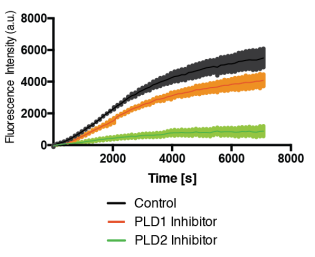
Live-Cell Real-Time Phospholipase D (PLD) Activity Assay under Mechanical Force
A continuous, live-cell enzyme-coupled fluorescent assay (Amplex Red / HRP / choline oxidase) designed to quantify phospholipase D (PLD1/PLD2) catalytic activity in real time. Successfully adapted for orbital shear-stress delivery in 96-well microplates, osmotic swelling, pharmacological inhibition, and volatile anesthetic exposure.
- Real-time continuous fluorescent readout of lipid signaling kinetics
- Adapted for in-plate mechanical stimulation (shear stress & osmotic stretch)
- Deployed across 5 peer-reviewed publications as primary functional readout
- High-throughput format for both enzyme readout and mechanical stimulation
Instrument
Published Method
Biophysical Instrumentation
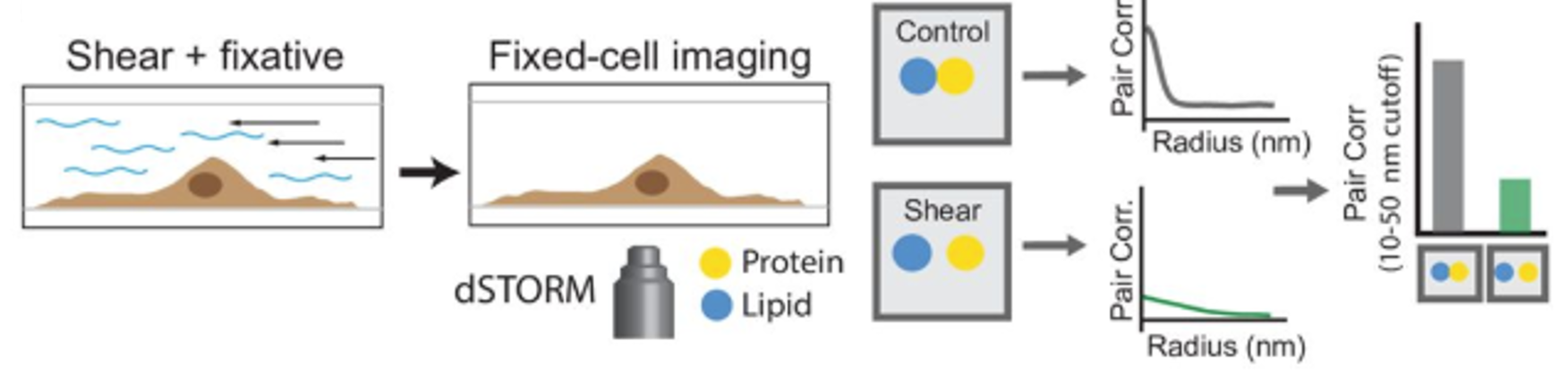
Temperature-Controlled Rapid Shear Fixation
Custom parallel-plate laminar fluid shear stress delivery system coupled with an in-line precision heater to eliminate thermal phase-transition artifacts. Incorporates an ultra-rapid dual PFA/glutaraldehyde chemical fixation injection protocol that traps mechanically stimulated nanodomain states in <10 seconds.
- Temperature clamping within ±0.1 °C to eliminate thermal lipid phase confounds
- Chemically traps non-equilibrium stimulated membrane states in under 10 seconds
- Preserves spatial organization of nanoscale lipid rafts and ion channel clusters
- Enables post-fixation super-resolution localization of activated states
Imaging
Published Method
Super-Resolution Imaging
Sub-Second Live-Cell 3D-dSTORM Super-Resolution
High-speed 3D single-molecule localization microscopy (dSTORM/SMLM) operating with individual frame acquisition settings of 200 fps (5 ms exposure) and an effective reconstructed video frame rate of ~250 ms per frame. Captures real-time nanodomain assembly, disassembly, and lateral translocation under shear force in live cells, overcoming the traditional limit of STORM requiring minutes per frame.
- ~250 ms effective reconstructed video frame rate for live-cell SMLM/dSTORM
- 200 fps acquisition camera settings on biplane 3D super-resolution optics
- Direct visualization of lipid raft disruption and mechanosensory translocation
Instrument
Published Rig
Behavioral Rigs & Systems
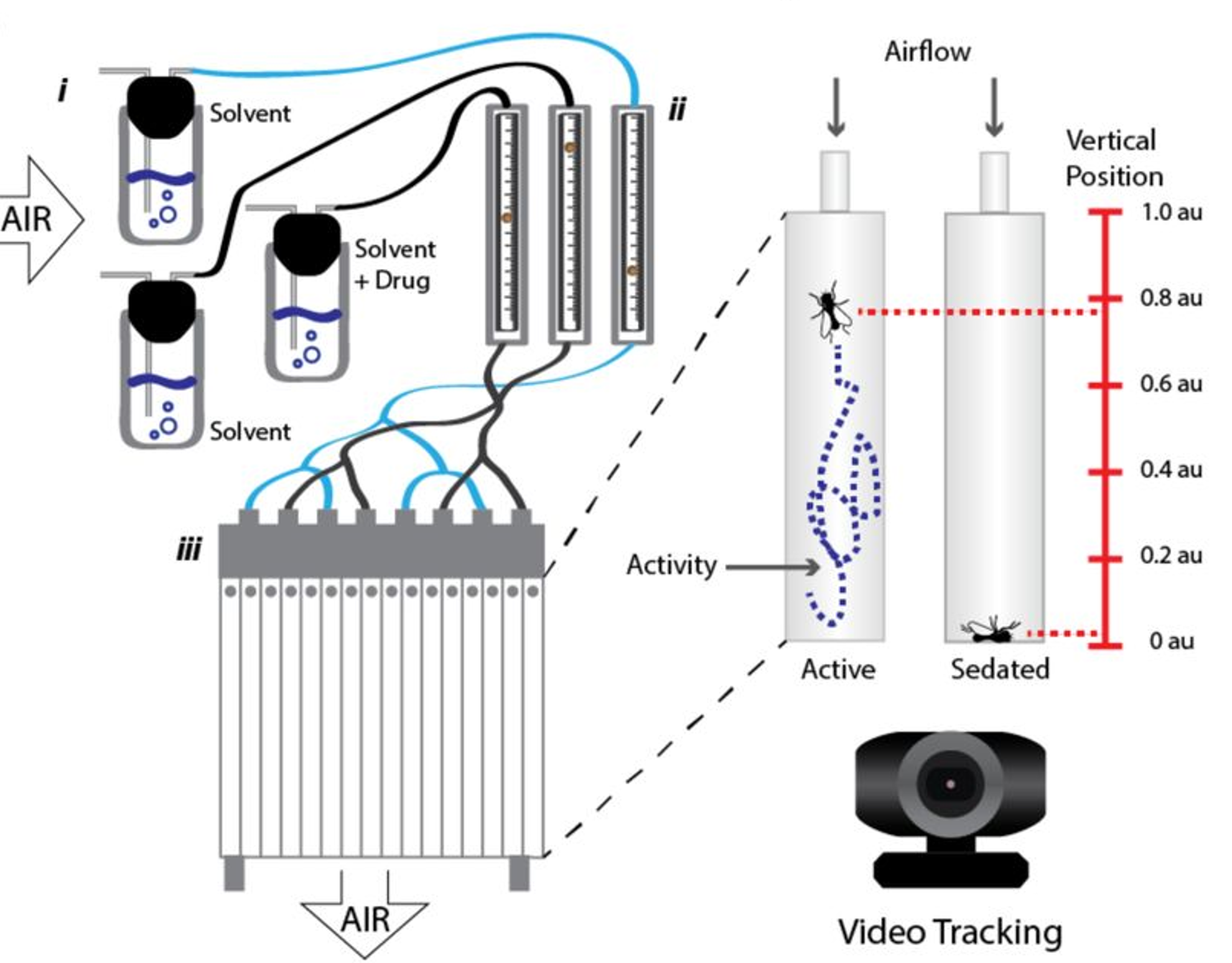
VAAPR Anesthetic Sensitivity Assay Rig
Volatile Anesthetic Administration in Parallel in Drosophila (VAAPR) is a custom narrow vertical chamber array with flow-controlled vapor delivery and automated animal tracking. Enables rapid, highly reproducible calculation of T50 anesthetic knockout sensitivity across genetic variants.
- Narrow vertical glass chamber array designed for precise gas delivery
- Flow-controlled volatile delivery system for chloroform, isoflurane, and diethyl ether
- Machine-vision positional recording for objective T50 determination
- Published in bioRxiv 2019 and deployed in landmark PNAS 2020 anesthesia study
Software
Private / Open Source
Software & Computational Tools
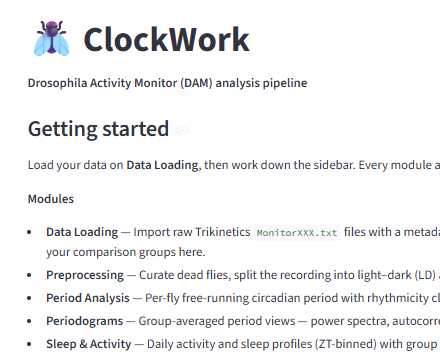
ClockWork Circadian Behavior Analysis Suite
Co-developer of an open-source modular Python package with an interactive Streamlit GUI for high-throughput circadian activity time-series analysis, Lomb-Scargle & Chi-square periodogram calculation, wavelet decomposition, and rhythmicity scoring.
- Modular Python engine for TriKinetics / DAM circadian activity data
- Interactive Streamlit web GUI for real-time visualization and filtering
- Automated periodogram calculation, period determination, and arrhythmicity scoring
- NetCDF allows for simple sharing of data and analysis parameters between researchers for publication
Rosbash Lab (HHMI/Brandeis)
Software
In Development
Software & Educational Tools
Microscopy Training Simulator
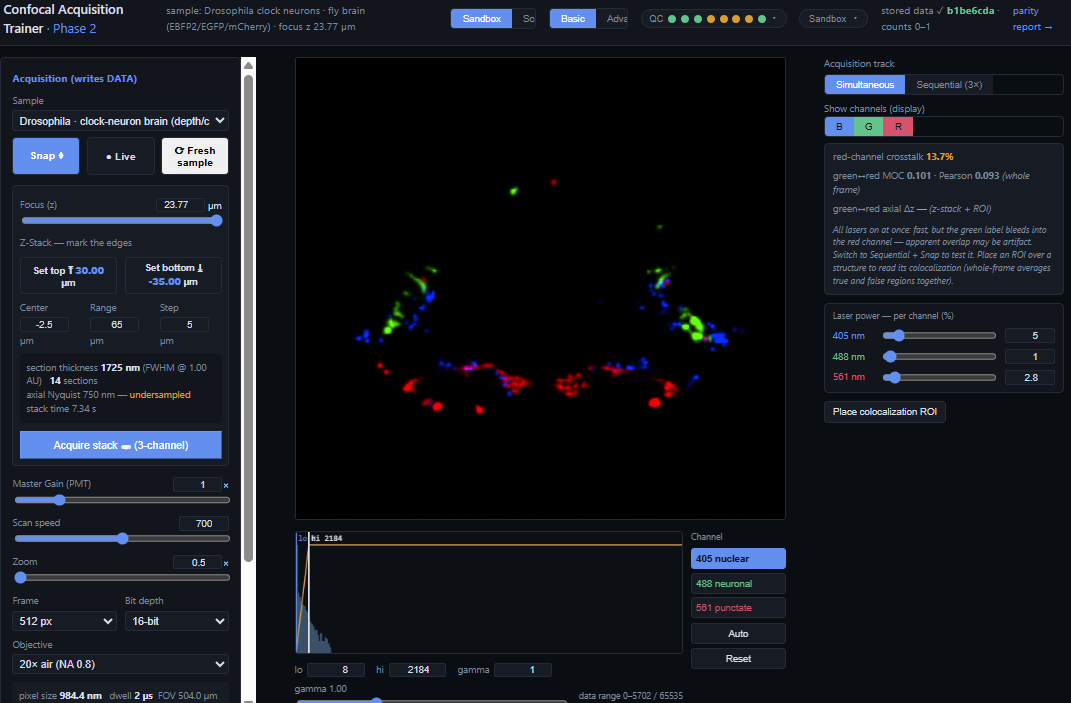
A browser-based microscopy simulator, in development, that teaches image formation by making it manipulable. The underlying model reproduces fluorophore physics (brightness, photobleaching, background) and propagates it through the instrument, so acquisition settings produce the image those settings would actually give. Advanced controls extend to parameters like pinhole diameter, simultaneous versus sequential channel acquisition, z-stack spacing and depth. Specimen models escalate from a cell monolayer, to C. elegans and a Drosophila brain, so the same principles are re-encountered under increasing difficulty of sample.
- Physics-based fluorophore model: brightness, photobleaching, background
- Acquisition parameters change the resulting image — pinhole diameter, simultaneous vs sequential channels, z-stack spacing and depth
- Teaches the trade-off behind each setting rather than a recipe to follow
- Built from a decade of hands-on super-resolution and confocal experience
- In active development
In progress